


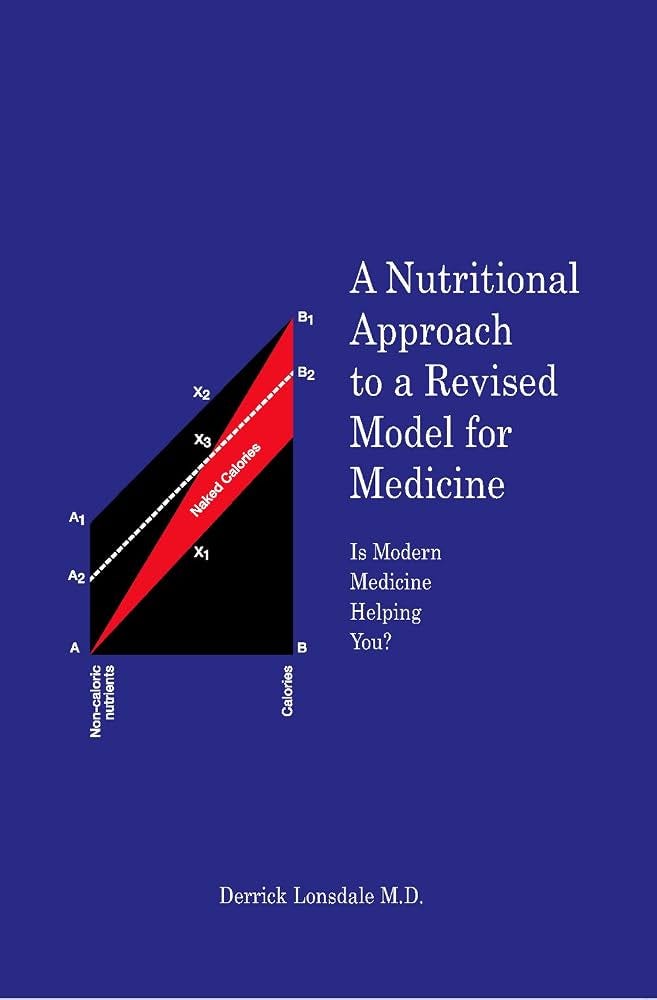
A Nutritional Approach to a Revised Model for Medicine. I know the title isn’t quite as poetic as The Physiology of Taste but there’s a lot of substance here that might make you think a little more about just what food means to you!
In fact, I’d say it’s a great follow up. Brillat-Savarin describes in such beauty the pleasure of the table whereas Dr Lonsdale dives deep into what happens to that piece of food once it gets into our system.
Here at the WARKITCHEN one of our ideologies has always been this notion that you can eat great tasting food that also nourishes you deeply. Why does healthy food have to be bland? Why does great tasting food have to wreck your gut? We’ve always fought for REAL nourishment - foods that nourish your body that also is incredibly tasteful.
I believe this book really helps you reframe what food is? Especially in a society where its really been degraded in the mainstream as to just how it feels and tastes in your mouth as opposed to one of then true functions of food which is nourishment for your mind, body and soul.
Derrick Lonsdale was born in Lancashire, England in 1924 and spent twenty years as a pediatrician at the Cleveland Clinic where he became head of the section of biochemical genetics. A six-year-old patient with a recurring neurological illness changed everything for him. From then on, his life’s work was vitamin B1, also known as thiamine. He kept treating patients into his late eighties and passed away in May 2024, ten days after his 100th birthday. What a beautiful life.
Fun fact - the word ‘vitami’” goes back to 1912, when a biochemist named Casimir Funk coined “vitamine” (from “vital amine”) while hunting for something in rice hulls that prevented a disease called beriberi. That substance turned out to be thiamine. So actually B1 is the original vitamin!
If you haven’t read this book yet, the big idea is what Dr. Lonsdale calls “high calorie malnutrition”(which is so so apt in 2026). It’s the notion that you can eat more than enough calories and still be malnourished, because the vitamins and minerals your body needs aren’t actually being consumed. Garbage junk food, Frankenstein sweet, endless snacking with “junk calories” but not enough nourishment. As he says, “It is not seen as malnutrition because we are not hungry as in starvation.”
Now without further ado, here are 25 quotes that we found particularly impactful, along with a few short notes. Feel free to comment with your own takes and any other quotes you found meaningful. Take this post as a resource you can always come back to!
Small note on the numbers: page numbers refer to the 167-page print edition (the one that I read). You’ll also notice Dr. Lonsdale calls the brain a “computer” over and over again. He was writing in a world of mainframes and hard drives, so the limbic system has a “program”, emotions are “files” and the brain “data processes” everything it receives. Once you get used to it, it’s really an interesting way to think about your body.
Two Brains, p. 7
“Functionally we really have two brains, the lower and more primitive limbic system and the upper cognitive. Sanity, and the normal behavior that goes with it, is brought about by a dialogue between them.”
This is really the lens for the whole book. Lower brain runs the automatic stuff: hunger, fear, anger, the fight-or-flight reflex. The upper brain thinks. When the two are in conversation, you feel like yourself. Dr. Lonsdale’s big argument is that the lower brain runs on fuel like everything else, and when it’s poorly fed it starts to shout over the upper one.
Physical and Mental Disease, p. 9
“Physical disease cannot be separated from brain function. All mental disease is just as physical as body disease is mental.”
Mind and body are one. It sounds obvious, but the mainstream largely treats it as two very different faculties. Plus, we have to realize that Dr. Lonsdale was saying this long before “nutritional psychiatry” was even a thing.
The Word Doctor, p. 10
“The word ‘doctor’ comes from the Latin doceo, ‘I teach.’ The original meaning of the English word, therefore, was ‘a teacher.’ It is only in recent times that the word has been used to indicate a healer. The doctor does not heal anyone. It is the body that heals itself and the doctor must teach the patient how to retrieve his or her own health and that is what the New Medicine is all about.”
This might be the most important idea in the book! Your body does the healing. A great doctor is really a teacher who helps you understand your own machine, so you can look after it every day and not just when something breaks. It’s what we try to do here too! Prevention and building a healthy strong body that’s nourished is one of the best things you can do for the quality of your life.
Snacking, p. 11
“It is often the in-between-meal eating that does the damage, not the three main meals routine. It is very hard indeed to get people to be aware of this and how it works against them.”
Most people have no idea how much they snack. And when I talk about snacks like this its often the ones that do you no good. It’s no problem to snack on real foods that nourish you but things get sketchy when you fill yourself with calories that give you nothing in return.
Living to 100, p. 16
“’Those who have the true wisdom remain strong, while those who have no wisdom grow old and feeble.’ The ideal age for man was one hundred years and this was considered to be due to living in harmony with heaven and earth, yin and yang, and the four seasons.”
Very interesting that he said the ideal age for man was a 100. We have to acknowledge that he actually went and lived a hundred years himself!! Remarkable. Also, I love how he’s also giving a nod to traditional Chinese medicine here and how he makes it a point to live with the four seasons (pssst it’s November and that means you should start soup / broth maxxing).

High Calorie Malnutrition - p. 20
“High calorie malnutrition is quite different from starvation and I have likened it to choking an internal combustion engine. It is the consumption of foods that may be tasty and satisfying, but have insufficient accompanying vitamin/mineral components, the path towards the appearance of beriberi if developed to the fullest.”
Notice that Dr. Lonsdale calls these foods “tasty and satisfying”. High calorie malnutrition doesn’t feel like malnutrition so the answer isn’t to eat less but to instead incorporate foods in the diet that has important vitamins and minerals.
Stress In Disease - p. 24
“The teachings of Hippocrates fit in easily with the concepts of ancient China. He taeught rest, diet, and ‘anti-stress’ as the foundation of treatment. He encouraged the body to become well by simply taking it out of commission for a while and letting it heal itself. The quality of diet was the most important thing that people could do for themselves.”
This is so WARKITCHEN coded. You need to be leisure maxxing. Let your light shine bright when you engage in deep meaningful work, then completely disconnect when it’s time to rest. Often times you find really beautiful ideas in between those periods.
“Leisure is a lost art. Nobody knows how to relax anymore. You don't rest by endlessly scrolling. You need to be doing things. Go for an aimless walk. Discover new cafés. Play a game of tennis. Stretch. Peruse niche magazines. Listen to an album from start to finish. Write. Smell the flowers. Soak in a warm magnesium bath. Bask in the sun. You need to let your subconscious ruminate while your body completely disconnects from work. This is how the greatest ideas in the world are birthed.”
Subconscious Solutions - p. 40
“A scientist goes to bed with the problem ‘on his mind’ and awakens with the solution. It is as though the brain works on its own and that is really not any different from putting complex information into a mainframe computer which ‘data processes’ it and arrives at a solution.”
Remember the dream notebook from our last book club? Really the same idea here. His point is that your brain keeps working subconsciously on whatever you hand it before you fall asleep. Read the problem over one last time before bed, then let it go! Keep that notebook by your bed. You might wake up with the answer in the morning or in the middle of the night (!!).
Beriberi - p. 45
“Later studies performed at the National Institutes of Health were able to show that he had a genetically determined weakness in the energy-yielding mechanism that uses Vitamin B1. We now recognize that such a person is ‘vitamin dependent’ rather than a simple dietary deficiency. This child required from 300 to 600 milligrams of thiamine a day in order to prevent the recurrent neurological episodes. The recommended normal daily dose of this vitamin is about 1.5 milligrams a day.”
This is the six-year-old boy who changed the course of Lonsdale’s career! Look at those numbers: 300 to 600 milligrams a day, when the official recommendation today is just 1.2 milligrams for men and 1.1 for women. That’s hundreds of times more. Interesting how some people simply need far more of a nutrient than the average person because of how they’re built. (Disclaimer: These doses were given under close medical care. Please don’t try this at home.)
