


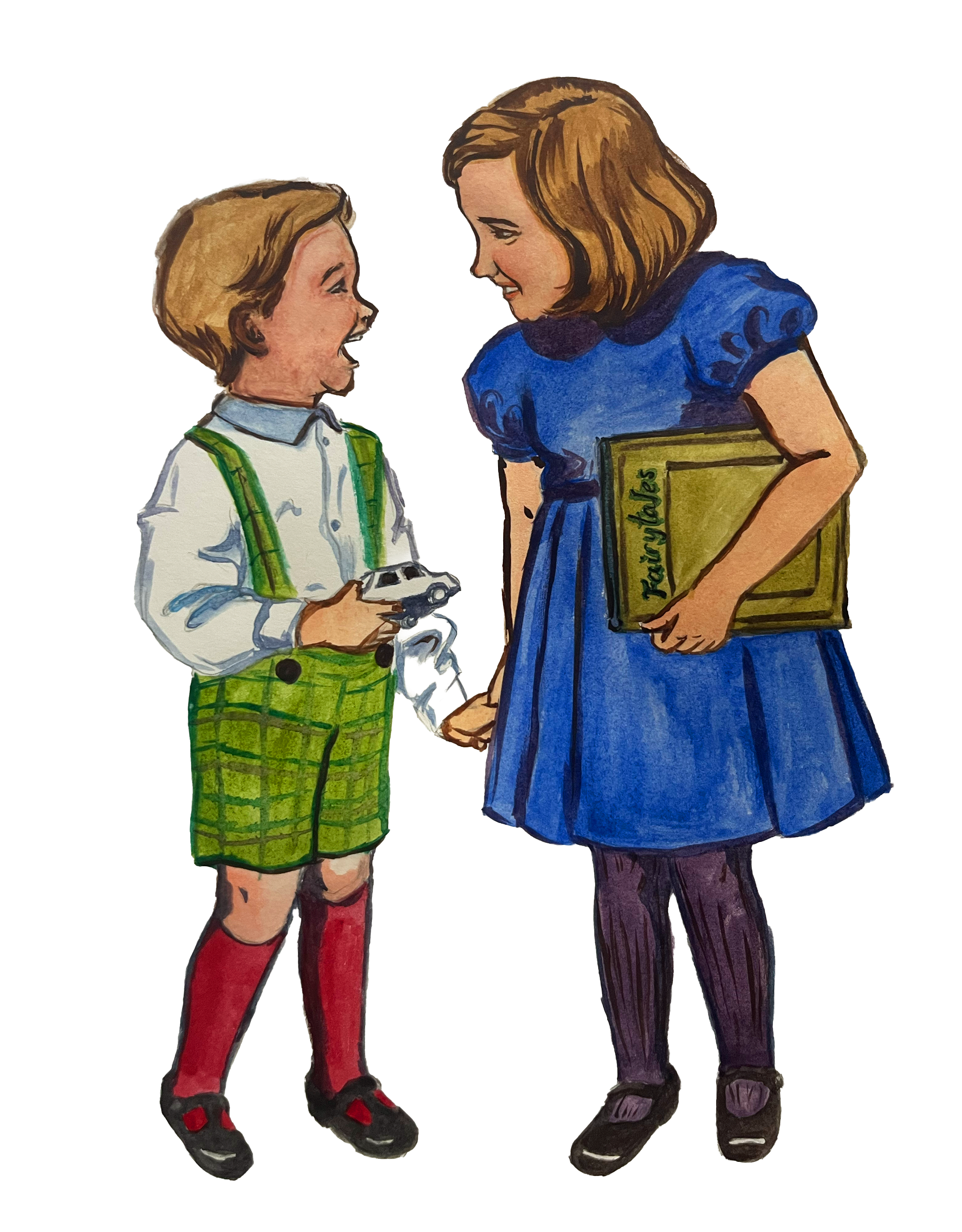
From the moment a baby is born, a mother’s instincts are activated, and her body knows exactly what to do to look after the precious little life placed in her arms. Her body produces milk in exactly the right quantity and of exactly the right composition. Her brain has been re-wired to hear and recognize her baby’s cries. Most importantly, she loves her little baby with an instinct and power that is incomparable to anything else on Earth and this best prepares her to lay the foundation for his proper education. There are many mercenaries who wish to make money by getting mothers to second guess their instincts but the “educational baby toys”, baby formulas and swings, are all inferior to the perfection of the mother’s presence and attention. Nevertheless, there is a time when mother’s milk is no longer enough and the baby becomes a child who needs more. In our modern world, “experts” instruct us to surrender our children to the care of nurseries and day cares for children as young as one year old. When institutionalized education was first introduced to human society, it did not begin until the child was six years of age, but it has since encroached further back into his childhood, and spread wider throughout his day. And it is not clear that this is the best environment for the crucial work to be done in the tender realm of “Early Childhood” to lay the foundations of character, emotional attachment, and a sense of beauty and wonder.
I am a mother of two young children and my repeated disillusionment with the “experts” due to the many ways they have misled us in matters of health and culture, has compelled me to do my own research on the truth about the best way to educate children in the early years. I wish to give my children the best advantages in life and these cannot be bought with expensive schools and prestigious tutors. Although it is a burden to live in a time where we are not given this fundamental wisdom perforce, it is also a blessing to be more intentional about our parenting strategies. I have learned a lot from Charlotte Mason, Erika Komisar and Gabor Maté’s research and writing as well as from hundreds of conversations with seasoned parents.
Spend Much Time in Nature
The healthy child has good posture, bright eyes, speaks clearly, walks with a spring in his step, tells the truth instinctively, and is overall brimming with life and joy. The experts who wish to tell us what to do, produce obese, indolent, contumacious, easily distracted children so we cannot trust their advice. How can we nurture the healthy child? First let us speak about forming the correct constitution of the body.
The child needs as much time as possible outdoors and in nature to get the oxygen necessary to invigorate the rapidly growing cells and to nourish the millions of neural connections that are forming. The child’s lungs need to expand and this is done best by being outdoors where shouting, singing and yelling, as is in the little child’s nature, is not irksome to indoor couch potato adults. The child in early childhood wishes to build up his muscles by running, jumping, frolicking and dancing and where best to do this but outside in a meadow where the soft grass will catch any tumble with the kindness of a mother’s arms. Many parents run themselves ragged baby proofing indoor spaces, attempting to mimic what nature offers for free in the form of a grassy meadow or a sandy beach. Even if you live in a city, taking the time a few times a week to drive out to a big park or the country-side is better than nothing.
“Her body produces milk in exactly the right quantity and of exactly the right composition. Her brain has been re-wired to hear and recognize her baby’s cries. Most importantly, she loves her little baby with an instinct and power that is incomparable to anything else on Earth.”
Nature also provides direct knowledge about the world to the child through his own experience and experimentation which must come before any kind of secondary, abstract learning from books and symbols. When the child spills all the water from a cup, he learns something about gravity. When the child spots the colors on a butterfly’s wings, a bumble bee entering a flower, or the softness of flower petals, he learns true things about the world first hand. He begins the use of his own mind and senses and awakens his sense of truth, for there are no truths more clear than the truths of nature. He is the active pursuer of knowledge rather than just the passive consumer. The child will begin to tell his mother all that he sees and the mother can give him vocabulary, and encourage him to be more precise, and descriptive, “Feel how prickly this pine needle feels compared to this soft leaf”. The child gains the habit of paying close attention to his observations, a habit which even many adults have lost in the age of cameras and technological distraction.
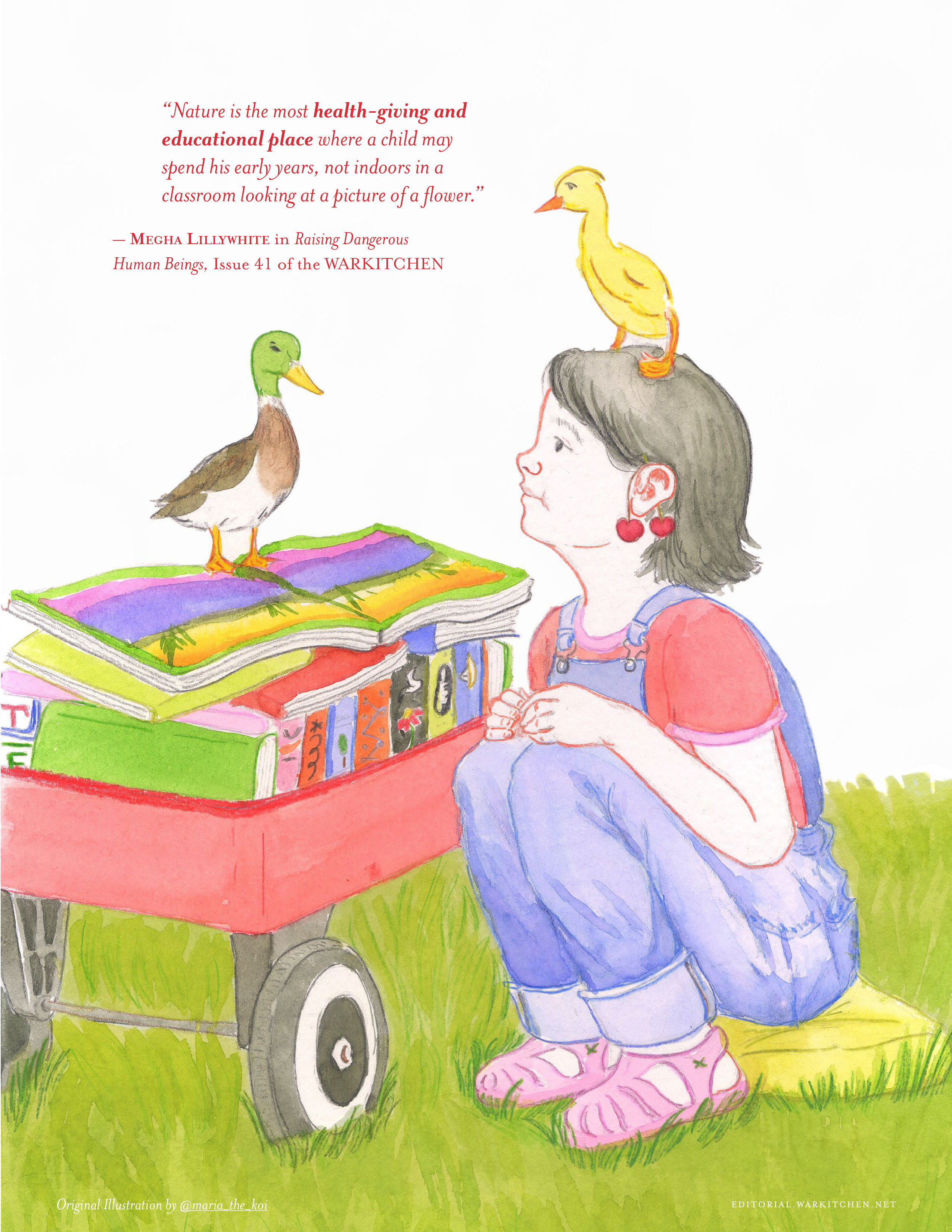
Children in nature also do not crave the constant entertainment of toys or screens. A stick, a flower, or following a little ant is enough to enthral a young child. Nature is the most health-giving and educational place where a child may spend his early years, not indoors in a classroom looking at a picture of a flower.
Good Habits
Good habits include things like saying please and thank you, brushing your teeth before bed, tidying up your toys but Charlotte Mason’s writing tells us that our character, temperaments and values are also matters of habit. The earlier a habit is formed, the stronger it lives in the constitution of the person. Habits of character and temperament derive from habits of thought.
The mother must be constantly vigilant to expose the child to good thoughts and to catch bad thoughts in their tracks and stop them. Good thoughts are those that comprise gratitude, beauty, kindness and optimism, and bad thoughts are those that are envious, bitter, resentful, self-victimizing and pessimistic. In order to help the child with this endeavor, however, the parents must also monitor and correct their own thought habits because children in Early Childhood learn most of all from modeling. What kinds of conversations are you having with your child? What is your own outlook on life? They are moments like these that show us how good parenting forces the adults to become better people as well and this is one of the few ways that children are a blessing to us. When the habit of a certain type of thought is formed, the track in the mind forms like a rut in the ground and widens and deepens as it writes itself in the child’s soul.
“When the child spills all the water from a cup, he learns something about gravity. When the child spots the colors on a butterfly’s wings, a bumble bee entering a flower, or the softness of flower petals, he learns true things about the world first hand.”
The habit of thinking bad thoughts leads into the formation of evil temperaments, and bitter personalities, whereas the habit of good thoughts leads to the formation of happy temperaments and virtuous personalities. In the process of helping our children become good, perhaps we might also be improved. Another habit that must be trained with care and perseverance in early childhood is the habit of attention.
Nurturing a Healthy Attention Span
Babies naturally have very short attention spans and their mind flits from this to that like a butterfly. Even the way that very young children talk mimics this effect because we see that their stories are guided by the law of association rather than narrative or theme; a talkative little girl will jump from the topic of juice to apples to the apple tree in granny’s backyard. However, even a little baby’s attention can be gently trained to stretch beyond its natural impulse, when the mother gently brings the baby’s attention back again and again to the little daisy she was looking at, pointing at the center, and now the petals, and now spinning it. The baby will look longer at a thing if the mother looks with her. Even if she looks for ten seconds instead of two, this is a major victory for the mother. Similarly, an older child can be asked questions and can be guided in her speech to stick to one subject when she tells a story rather than jump between a hundred unrelated topics, and thus grow up to be a good speaker. So much of the power of early childhood education is through presence and conversation, rather than explicit instruction in workbooks or lessons, and this is why it is so difficult to outsource; you cannot outsource love.
“Research shows that children who had the healthiest attachment to their parents immediately crawled or toddled away to explore when entering a new room, whereas babies with insecure attachments hesitated to leave their mothers because they were afraid she might leave.”
Other ways to increase the attention span in early childhood is to limit cartoons and if they are shown at all, then choose lower stimulation cartoons that have longer frames and complex stories. Angelina Ballerina, Rupert Bear, Little Bear are all great examples. Choose toys that allow the child to develop and employ her imagination while she plays rather than little stimulation machines that sing, dances and entertain. Refusing to give children new toys simply because they’re “bored” and allowing them to be bored is another way to nurture a child’s attention span and imagination. The child will invent new ways to play with open ended, beautiful toys if given the opportunity. Paying attention to one task is difficult for adults and children alike. It is only a mind that has developed the habit of paying attention that can ever learn anything, or make any use of a person’s talents and skills.
Emotional Attachments
Yet none of the formative work of early childhood is possible without strong emotional attachments and the person best equipped for this attachment is the mother. It is only when a child has healthy emotional attachments that she is prepared to pursue her curiosity. Research shows that children who had the healthiest attachment to their parents immediately crawled or toddled away to explore when entering a new room, whereas babies with insecure attachments hesitated to leave their mothers because they were afraid she might leave.
Unfortunately, not all families have the luxury of a mother who can stay with her baby in the early years. Daycare and nurseries are a common form of childcare employed by families who require two incomes in order to survive in today’s economy. However, Erika Komisar’s research reveals that children who are sent to daycare report higher stress levels than children who stay home with their mothers and this not only remains consistent well after the early years are over but is also a good predictor of mental illness in the teenage years. While some daycares and nurseries may be very wholesome, and a dual income may allow parents to live in safer neighbourhoods, these benefits must be balanced against the facts of attachment in early childhood. The child under five is designed to form strong emotional connections very quickly. If they are spending the majority of their day with a nursery worker and form bonds that are periodically ripped away due to staff changes, it is a major source of distress for the child and impairs their abilities to bond in the future.
Many parents also choose daycares because they believe that they will provide the child the opportunity to socialise. But the research on early childhood by Gabor Maté reveals that children in this phase of life are not equipped to form real friendships. Attachment is a unidirectional relationship in which a child benefits and the adult compromises and gives, whereas a friendship between peers is reciprocal; both must benefit and show maturity toward each other, which a child under five is just not developmentally ready for. In fact, a healthy emotional attachment in the early years with a mature and patient adult is exactly what prepares a child for healthy friendships later in life.
“Beautiful books cultivate the sense of beauty in the child even in infancy, supplying beautiful images, beautiful language, and virtuous ideas.”
An alternative to daycares is using an alloparent, such as a consistent nanny, baby-sitter, or relative. This is someone that the child may safely bond with while providing the childcare support that parents may need. However, no substitute will ever be as optimal as the mother in early childhood.
Attachment is also undermined when parents are physically present but emotionally absent. Making eye contact, listening patiently, responding with genuine interest, and including the child in daily hobbies and chores all nourish this attachment. Such presence may feel tedious but it is irreplaceable. Seeking respite through trusted help from husbands and relatives, making friends with other mothers can help re-charge our own batteries. Parenting invites adults to re-live the magic of childhood and the more you lean in, the more both you and your child benefit.
Nurturing a Sense of Beauty
Early Childhood is where the most crucial spiritual foundations are laid in a child’s heart and soul, which will continue to nourish him throughout his life. It is for this reason that it is very important to expose the child to great beauty, good quality language, and good ideas. Charlotte Mason describes an idea as “more than an image, or a picture; it is a spiritual germ endowed with vital force - with power, that is, to grow and to produce after its kind” (Charlotte Mason, Home Education Vol 1). When a child is given good ideas, their curiosity will be primed to seek more good ideas on their own as they grow.
Beautiful books cultivate the sense of beauty in the child even in infancy, supplying beautiful images, beautiful language, and virtuous ideas. As the child grows, these stories and images will be preferred due to nostalgia and thus strengthen in their power over the child through emotional valence. Books that use “twaddle” as Charlotte Mason calls it, or baby language are to be avoided as well as books with ugly or overly simplified illustrations. Children even in early childhood are capable of so much more than we are led to believe by modern pedagogy and when children are taken seriously they flourish. Examples of great children’s book authors are Judith Kerr, Andrew Lang, Hans Christian Andersen, Beatrix Potter, JM Barrie, Michael Morpurgo, and Raymond Briggs to name a few.
“So much of the power of early childhood education is through presence and conversation, rather than explicit instruction in workbooks or lessons, and this is why it is so difficult to outsource; you cannot outsource love.”
Reading a little boy or girl of four “Treasure Island” or “Charlie and the Chocolate factory” is preferable to letting them languish in the baby books that modern book stores would foist on them. Children really do understand stories and can follow along, if only we let them. Rather than giving babies flip books with sound playing gimmicks, show them beautiful pictures and put them at her eye-level and you’ll find that she is much more engaged with an Edmund Dulac, Beatrix Potter or Annie Stegg illustration because of the details, the colors and
the beauty.
Raising Dangerous Human Beings
In an age obsessed with academic achievement, worksheets and measurable milestones, we must reclaim the immeasurable and intangible qualities that comprise the proper education of a young child. Early childhood is for forming strong emotional attachments that breed a courageous heart, strong bodies that are capable of housing a strong spirit and mind, and habits that will nurture good character. No amount of money can buy the tenderness, love and patience that this kind of education requires. The most valuable thing to the child under five is the interest and presence of his parents and especially his mother. Children ought to emerge from early childhood confident, bright eyed, happy and with a healthy curiosity and reverence for beauty. Before you get caught up in the prestige of a nursery or the pride of an extracurricular activity, consider this essay, and whether the fundamentals are looked after first, and we may one day people the world with more wholesome, dangerous, and dynamic human beings rather than resumes to be uploaded to LinkedIn.

Megha Lillywhite is a writer and classical illustrator. She publishes Classical Ideals, where she discusses modern culture, art history and philosophy. Subscribe at classicalideals.press to read more of her work. You can also follow Megha on Instagram @meghalillywhite and on X @megha_lilly.

This piece was first published in Issue 41 of the WARKITCHEN, explore the rest of the issue here. Enjoy the experience 🥂

The illustration has strong Shirley Hughes vibes and I love it.
Fantastic piece!