

The “mold in coffee” conversation has become a hot-button topic in health and wellness circles, so much so that some brands now market “mold-free coffee.” That raises fair questions: What exactly are people talking about? Is it a real concern, a quality issue, a health issue, or mostly marketing? Let’s break it down in the truth of how coffee is actually produced, shipped, and roasted.
Words by Andrew Sinclair
What Exactly Does Mold in Coffee Mean?
In professional coffee terms, “mold” usually points to a problem that happens before roasting, at the green coffee seed stage, especially during post-harvest drying, storage, or shipping.
Coffee is an agricultural product. If green coffee seeds sit too long at the wrong moisture conditions, think warm, humid environments, slow or uneven drying, or storage conditions where coffee can reabsorb moisture, fungal growth becomes more likely. That doesn’t mean you’ll see fuzzy mold on a seed. Often, the first sign is a musty aroma or flat, stale flavors that show up later in the cup. Two technical measurements matter here:
Moisture content (how much water is in the seed)
Water activity (how available that water is for microbial growth)
Water activity is especially important because it correlates with the conditions that allow certain molds to grow and potentially produce toxins.
The Real Contaminant Concern - Ochratoxin A
When mold in coffee becomes a health conversation, it’s typically because of Ochratoxin A (OTA), a mycotoxin - that is, a toxin produced by certain molds - most commonly associated with aspergillus and penicillium. It’s a chemical compound that can be produced under the right conditions, especially when food or agricultural products are dried or stored poorly.
OTA matters because toxicology research has shown it can affect the kidneys in animals, and it’s treated seriously enough that some regions set maximum limits for it in foods, including coffee.
What Roasting Does (And Doesn’t) Do
Here’s what often gets oversimplified online: roasting will kill all living microbes, including molds. But mycotoxins are not the same thing as living mold, and they can be more heat-stable, similar to the abundance of other volatile compounds we love to taste in coffee.
The good news is that coffee roasting can and does substantially reduce OTA - the literature shows reductions ranging roughly 70 to 95 percent, depending on roast conditions and starting contamination levels. The important nuance is that “substantially reduced” is not the same as “guaranteed zero”.
“Most professionals describe it as a chemical or soapy flavor. I find the largest taste descriptor of mold flavor damage is when coffee tastes like soap.”
So the practical takeaway is:
Roasting makes microbial growth a non-issue in
brewed coffeeQuality and supply-chain handling are what matter
most upstreamIf a coffee ever had a handling problem, what typically survives into your experience isn’t “mold”, it’s flavor damage or off flavors
How Mold-related Problems Show Up in the Cup
In the roasting world, the most common sensory fingerprint of poor storage or moisture exposure is what we call “bagginess” - a dull, stale defect often detected first in fragrance and aroma.
Typical baggy descriptors:
musty / damp basement
wet cardboard
old towel
papery, woody, flat, “warehouse” character
On the palate, it can taste lifeless and dusty. Most professionals describe it as a chemical or soapy flavor. I find the largest taste descriptor of mold flavor damage is when coffee tastes like soap.
Should You Be Worried About “Literal Mold” in Your Coffee?
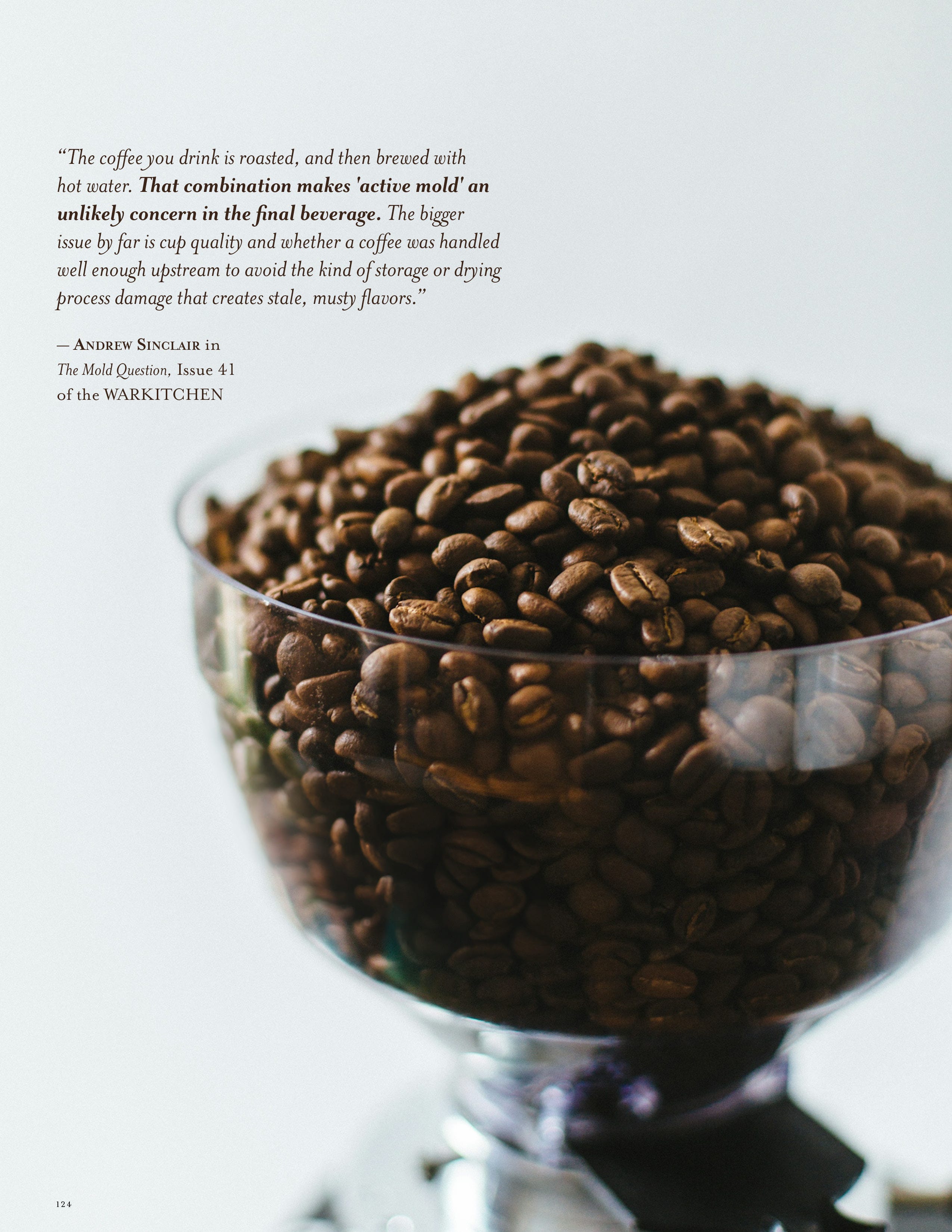
For most people, no. The coffee you drink is roasted, and then brewed with hot water. That combination makes “active mold” an unlikely concern in the final beverage. The bigger issue by far is cup quality and whether a coffee was handled well enough upstream to avoid the kind of storage or drying process damage that creates stale, musty flavors. It’s also worth being realistic about mold and its relationship to coffee. OTA and other mycotoxins aren’t unique to coffee. They can show up across the food system especially in products that are dried or stored for long periods. So when a brand sells “mold-free coffee,” the right question isn’t “Is everyone else selling mold?” - it’s: What standards and testing are they using? Are they sourcing fresh crop? How is green coffee being stored and shipped? Are they being transparent? “Mold free” isn’t a regulated phrase in the way most consumers assume. The real conversation is quality control, good storage, and responsible sourcing.
How to Avoid Off Flavor Coffee
Buy Fresh Crop Coffee Seeds
Fresh crop matters. Coffee can remain excellent for many months when stored properly, especially in protective packaging, but once you’re well into the previous harvest year, risk goes up (staling, storage notes, and general flattening). Pay attention to the harvest year/season, or buy from roasters who can and will tell you.
Buy From Roasters You Trust
A good roaster should be able to answer, “Is this fresh crop, and how was it stored/shipped?”. If they can’t answer basic sourcing questions, you’re guessing.
Be Cautious With “Mystery Dark Roasts”
Dark roasting, or heavy development roasting, has its place. But it’s also true that pushing heavy roast development can mask defects. If a roaster known for light/medium roasts suddenly drops a “special” very dark or developed offering with vague sourcing, it’s reasonable to ask why.
“If you want cleaner coffee, skip the fear marketing and focus on what actually predicts quality. Fresh crop, transparent sourcing, careful storage, and a roaster who treats coffee like a perishable agricultural product, not a shelf stable commodity.”
Avoid Marketing That’s Louder Than the Experts in the Coffee Industry
If the pitch is mostly fear, “every coffee expert missed this for 100 years but we discovered this all of the sudden” that’s a massive red flag. Coffee quality is a global industry with real standards, real labs, and very serious import/export requirements. No one has discovered a secret toxin or secret poison that the entire coffee world somehow ignored.
Ask About Protective Liners
One of the biggest practical improvements in green coffee trading and green coffee quality has been the use of hermetic liners like GrainPro liners. These reduce moisture exchange during shipping and storage and help preserve freshness. Even if you’re not buying green coffee yourself, you can ask your roaster whether their coffee comes in hermetic liners. Roasters who pay attention to that detail usually handle coffee more carefully across the board.
Treat ‘Aged,’ ‘Monsooned,’ and ‘Long-Stored’ as Intentional Exceptions, Not Defaults
Some of these styles are traditional and can be enjoyable, but they’re not the best bet if you’re trying to minimize musty/storage driven flavors. If your goal is “clean, vibrant, fresh,” buy fresh crop coffees that are clearly positioned and stored for that outcome.
For most coffee drinkers, “mold in coffee” is not a daily health crisis. For coffee professionals it’s not even a health crisis, it’s just a bad tasting cup of coffee we’re not going to drink again. It’s primarily a green coffee handling and storage conversation, and in the cup, it usually shows up as staleness, mustiness, and flat flavor, not as literal mold. If you want cleaner coffee, skip the fear marketing and focus on what actually predicts quality. Fresh crop, transparent sourcing, careful storage, and a roaster who treats coffee like a perishable agricultural product, not a shelf stable commodity.
Andrew and Sarah Sinclair are the owners of Mad Lab Coffee in Los Angeles, California, a specialty coffee roaster and café built on the belief that great coffee should be both deeply intentional and genuinely welcoming. Their approach blends rigorous craft, careful sourcing, precision roasting, and repeatable brewing standards with a hospitality-first experience that makes customers feel at home.
Andrew brings a systems-minded, technical lens to the work, obsessing over the variables that shape flavor from roast development and extraction metrics to water and equipment calibration so every cup is clean, expressive, and consistent. Sarah anchors the brand and the room, focusing on service, culture, and the details that turn a coffee stop into a place people return to: clarity, comfort, and connection. Read Sarah’s piece on Rituals, Balance & Coffee here.
Together, the Sinclairs have grown Mad Lab Coffee into a Los Angeles community staple equal parts craft and care where the work is serious, but the vibe is never pretentious.

This piece was first published in Issue 41 of the WARKITCHEN, explore the rest of the issue here. Enjoy the experience 🥂
❋ Winter 25/26 Coffee Table Book (Print)
❋ Explore the full WARKITCHEN archive here.
❋ Got an article or recipe in mind? We’d love to hear more! Please send your pitch to rocky@warkitchen.net.