


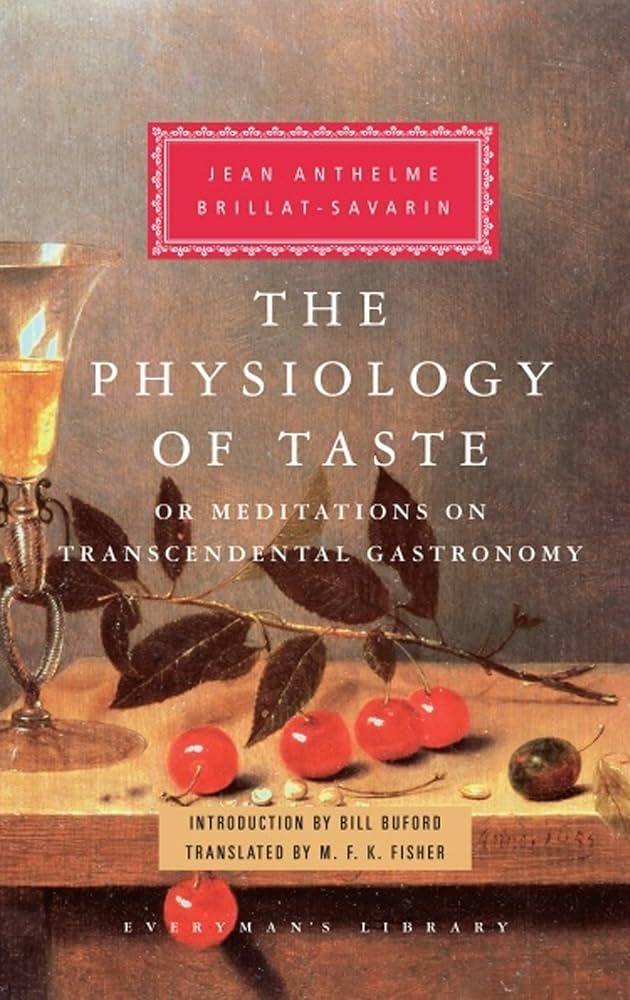
The Physiology of Taste. What a beautiful name for a book, isn’t it? And if you’ve been reading along with us these past two months, what an intriguing read!
It’s apt that we’re starting the WARKITCHEN book club with an absolute classic of gastronomy. Whenever I read old books like this I can’t help but think about how special it is for a writer’s words to have transcended so much time.
I mean, just think about it! This book was first published in December of 1825. By a 70 year old anonymous lawyer who had been penning these thoughts down over most of his adult life. A man who died just two months after the book was published, a man who never lived to realize the impact his words would have had on the world.
A note before we begin. We obviously don’t agree with everything in the book (!!). Some of it is wrong by the standards of what we know now and others are opinions that we don’t agree with. I’m sure if you’ve read it you must feel the same way. One example is how he tells us that fish is much less nourishing than red meat, which was perhaps a reasonable read in 1825 but poor today. He had no way of knowing about omega 3s, or that DHA would turn out to be so essential for the human brain.
But hey that’s part of the fun! You also get to think about a number of things like taste, hunger in ways you never quite have.
Instead of doing a traditional book review we’re going to leave you with 25 quotes that we found particularly impactful along with a few short notes. Feel free to comment with your own takes as well as any other quotes you found meaningful. Take this post as a resource you can always come back to if you would ever want to revisit any of these topics.
Small note on the numbers: the “§” marks are Brillat-Savarin’s own section numbers and they work in any edition, in any translation! Page numbers refer to the Everyman’s Library edition, translated by M.F.K. Fisher, with an introduction by Bill Buford (the one that I read).
Just before we get to Brillat, I want to give Bill Buford his due! Introductions to most books are usually pretty boring and don’t add to them at all but Buford has done such a great job with this. It really sets you up perfectly. He talks about the aphorisms at the start of the book and a few that he resonated with (these are also some quotes you may have read or heard in everyday life):-
A meal without cheese is as incomplete as a woman without an eye
A dinner is never boring, at least for the first hour
A new dish matters more to human happiness than the discovery of a star
You are what you eat
He closes the introduction with a quote that’s pretty magical:
“Food is more than itself. It is not everything, but it is touched by almost everything: memory, weather, dirt, hunger, chemistry, the universe.”
If you have this edition, I highly recommend reading the introduction. Without further ado, here are 25 quotes from The Physiology of Taste worth sitting with!
Aphorism II - p. 3
“Animals feed themselves; men eat; but only wise men know the art of eating.”
Three verbs for the same act, arranged in ascending order. This is the whole book in one line, and he puts it second.
§6, Definition of Taste - p. 39
“Taste is the sense which puts us in contact with savorous or sapid bodies, by means of the sensation which they cause in the organ destined to appreciate them.”
It’s interesting how ‘physical’ he describes taste here. It really is a physical sensation, even though most of us think of taste as a mental one. We have to remember that taste will always be a sense. In modern day the word taste almost means judgement. Brillat-Savarin describes it as almost a form of reaching out and finding the world itself.
§18, Definition of Gastronomy - p. 61
“Gastronomy is the intelligent knowledge of whatever concerns man’s nourishment.”
Gastronomy is just knowledge. It’s not about recipes, cooking techniques, skill but just knowledge about man’s nourishment. So apt.
§14, The Supremacy of Man - p. 43
“Among fish it is but a movable bone; among birds in general it is a membranous cartilage; in the four-legged world it is often sheathed with scales or roughnesses, and moreover has no power of circular movement.”
He’s building an argument that human taste is the most developed in nature, and he gets there by cataloguing tongues. It’s really something we don’t think about usually and at times take for granted.
§15 - p. 45
“movements of SPICATION, ROTATION, and VERRITION”
He uses words from Latin! Verrition comes from verro, meaning I sweep. That’s the motion your tongue makes hunting for a piece of food caught between your lip and your gum.
§15 - p. 45
“Man, on the other hand, is omnivorous; everything edible is prey to his vast hunger, and this brings out, as its immediate result, tasting powers proportionate to the general use which he must make of them.”
This is my favorite quote from the book and a point that we’ve talked about several times here - it’s what encompasses the WARKITCHEN ideology behind what we should and shouldn’t eat.

§23, Definition of Appetite - p. 68
“MOVEMENT AND LIFE cause a steady loss of substance in any living being; and the human body, that highly complicated machine, would soon be useless if Providence had not placed in it a sentinel which sounds warning the moment its resources are no longer in perfect balance with its needs.”
Love the way Brillat-Savarin describes appetite to be almost like a guard posted at the gate. Hunger - for as long as humans (and even animals) have been around has always been one of the most important biological mechanisms there is. Also makes you think about what these new-age GLP1s are doing. Are there really no ramifications to permanently switching off your hunger? Does losing your hunger for food affect your zeal for life? I guess we’ll find out in the years to come.
§49, Differing Kinds of Thirst - p. 129
“Latent or habitual thirst is the unconscious balance which is established between bodily evaporation and the need to replenish the vaporized moisture; it is this which leads us, without our feeling any misery because of it, to drink during our meals, and makes us able also to drink at almost any time of the day. The thirst is always with us and in its way is part of our very existence.”
Thirst is truly always with us. This is why it’s so important to stay hydrated if you want to be your best self and this doesn’t mean just sipping water. You need to be constantly replenishing this “vaporized moisture”.
§16, The Origin of Sciences - p. 59
9. “The man who first expressed by symbols the very simple proposition that two plus two equals four created mathematics, that most powerful of sciences, which has truly elevated mankind to the throne of the universe.”
He’s implying that gastronomy deserves to be treated as science and this is something I’m not entirely on the same page on. Perhaps with baking, yes. It’s definitely a science. But cooking for me has always been more of an art form. Especially when you rely less on the recipe and more of how things just flow and taste on the fly. Those are when you make the best meals - you inject an ingredient that you cannot really quantify.
§17, Origin of Gastronomy - p. 60
“Naturally! How could anything be refused to one who succors us from our birth to our burial, who adds to the delights of love and the strength of friendship, who disarms hatred, makes business easier, and offers us in our short span of life the sole pleasure which, since it is not followed by fatigue, remains to comfort us when the others no longer can?”
He’s right. Food does touch every part of life. I would say it’s the only pleasure that isn’t followed by fatigue when we talk about REAL FOOD. This is why we’ve always said it’s so important to judge food by how it makes you feel after the meal. Real food leaves you feeling amazing. Like what Brillat-Savarin describes, there is no fatigue. BUT if you eat modern frankenstein creations like a full upsized McDonald’s meal with ultra processed weirdo ingredients and french fries soaked in canola oil you’re almost definitely going to feel fatigued and drained of life after. Food for thought.
