


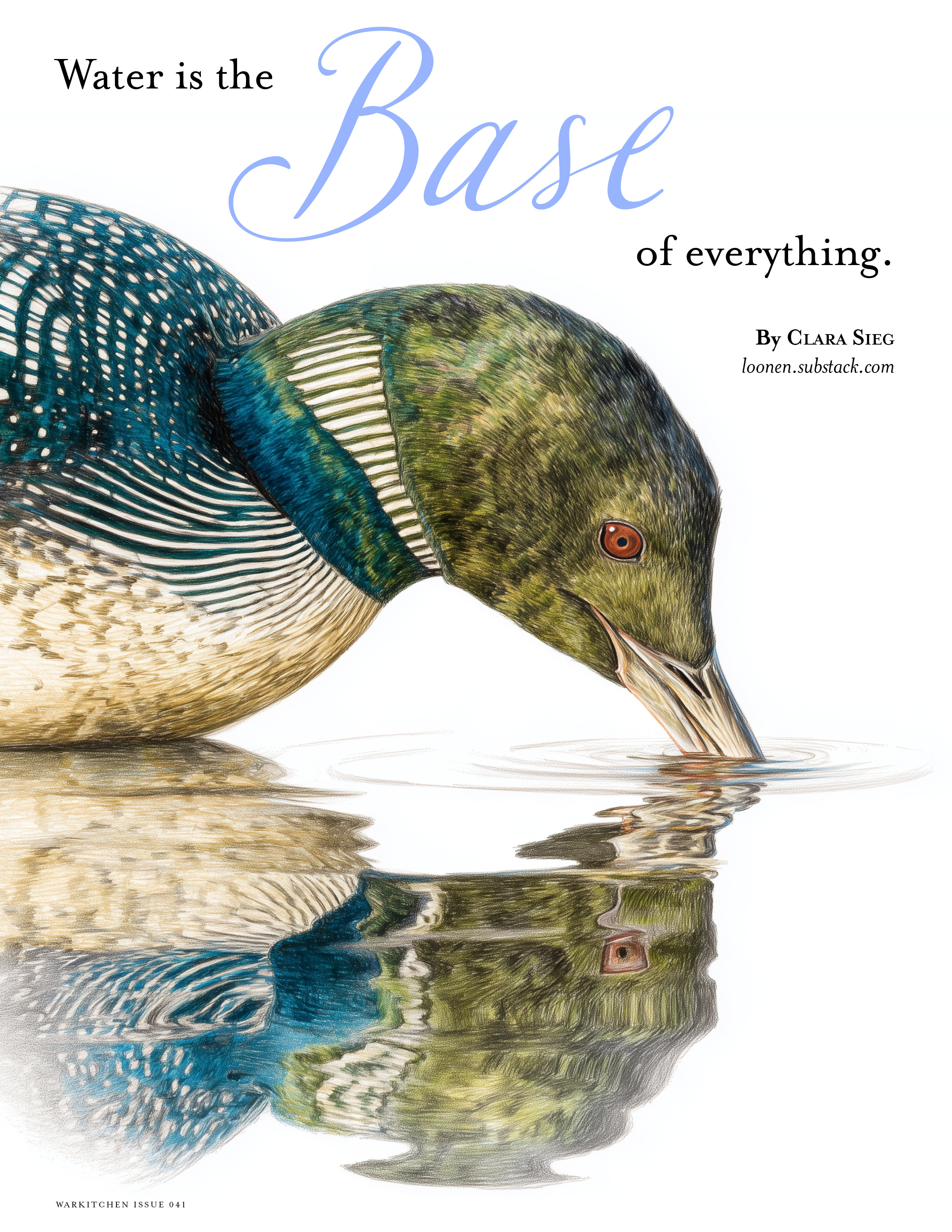
Long before we measured our health in biomarkers and supplements, life organized itself around water. Well, it still does. Migration patterns follow it, herds travel for it, birds cross continents looking for the right lakes and rivers. The smallest changes in water quality will quietly transform entire ecosystems.
You’re made up of roughly 60% water. For newborns it’s closer to 75%. Every nutrient travels through water. Every cellular process depends on water. It’s the single most consumed substance in life. Yet it’s the input we tend to question the least. For most of human history, we paid very close attention: where it came from, how it tasted, what it looked like, how it changed through the seasons. Today, water is largely treated as infrastructure, managed by systems most of us rarely think about.
Legacy System
Public drinking water in the U.S. is regulated under the Safe Drinking Water Act (SDWA), passed in 1974. While there have been incremental updates since, many of the most significant contaminant standards date back decades, including rules on disinfection byproducts (1998), radionuclides (2000), and arsenic (2001). In 2024, the Environmental Protection Agency (EPA) established the first national drinking water standards for PFAS, often called “forever chemicals.” The rule is currently facing legal and political challenges, and full compliance will be phased in through 2031.
As a result, much of today’s regulatory framework was built around legacy contaminants and has struggled to keep pace with newer classes of chemicals. EPA standards are not set purely based on health. The agency defines a health-based goal (MCLG), but the enforceable limit (MCL) is based on what is feasible, taking into account cost and available treatment technology. That distinction matters. The number reported in your water may not represent the ideal level for health, but rather what can be achieved across large systems.
Take arsenic as an example:
EPA health goal (MCLG): 0
EPA enforceable limit (MCL): 10 parts per billion
EWG guideline: 0.004 parts per billion
There’s a huge gap between what’s ideal in terms of health, and what’s practical for existing infrastructure to achieve.
MCLG (Maximum Contaminant Level Goal): the level at which no known health risk exists. Non-enforceable.
MCL (Maximum Contaminant Level): the enforceable legal limit, set based on what's achievable with current treatment technology and cost.
These two numbers are often very different.
What About Bottled Water?
Bottled water typically falls into two broad categories: heavily treated and municipally sourced, or minimally treated and naturally sourced.
“For most of human history, we paid very close attention: where it came from, how it tasted, what it looked like, how it changed through the seasons. Today, water is largely treated as infrastructure, managed by systems most of us rarely think about.”
Heavily Treated and Municipally Sourced
The starting point is tap water, which is typically disinfected with chlorine or chloramines to kill harmful microbes. These disinfectants can react with natural organic matter to form disinfection byproducts such as trihalomethanes (THMs) and haloacetic acids (HAAs). Long-term exposure to elevated levels of these compounds has been associated with health risks, which is why they are regulated.
These byproducts are relatively small and soluble, and while treatment can reduce them, they’re not always completely removed and can continue to form as water moves through the distribution system.
The water is filtered and rebottled - often under language like “reverse osmosis” or “micro-filtered” - which may sound elevated, but the source is the same water that runs through city pipes. While these processes can significantly reduce many contaminants, they don’t necessarily eliminate everything, and the original source still influences the final composition. Modern filtration is effective, but not absolute.
Minimally Treated and Naturally Sourced
Whether it’s spring, artesian, mineral - naturally sourced waters cannot be purified if they want to retain their labeling name. These naturally-sourced waters are marketed as untouched, which is true, but “natural” doesn’t always mean pure. These sources all pull from groundwater, and groundwater pulls from everything around it, which, in our globally connected water system, can also contain agricultural runoff and other pervasive pollutants.
Minimal treatment preserves the “natural” mineral profiles, but the result is water that sounds wholesome yet can legally contain trace contaminants that often fail modern health-based benchmarks. So while the labels read “pure” or “natural,” what’s in the bottle is often ordinary, or worse.
It’s not just about source or filtration, both are critical. And neither works in isolation.

“Long before we measured our health in biomarkers and supplements, life organized itself around water. It still does. Migration patterns follow it, herds travel for it, birds cross continents looking for the right lakes and rivers. The smallest changes in water quality will quietly transform entire ecosystems.”
Then There’s the Container
Glass, once the standard, has nearly disappeared from mainstream bottling because it’s slower and more expensive to produce. A glass bottling line runs about 400 bottles per minute. A PET plastic line can fill 2,000 per minute, and a can line can hit 2,500 or more.
Most bottled water now lives in some form of plastic: bottles, plastic-lined aluminum, or plastic-lined cartons. And yes, aluminum cans are plastic lined, because while aluminum doesn’t rust like iron, it still corrodes when it meets liquid. So without that thin plastic barrier, your can would start to dissolve into your water. And the cap matters, too. A recent study found that some glass-bottled beverages contained even more microplastics than those packaged in plastic. That may sound counterintuitive, glass itself is inert and doesn’t shed plastic, but the explanation lies elsewhere. Researchers traced the contamination not to the bottle or the inner liner, but to the external decorative finishes on caps. These finishes are often made from epoxy - or polymer-based coatings - fancy words for plastic - used for color and branding. During manufacturing, transport, or handling, these painted and printed layers can chip, introducing microscopic plastic particles into the bottle.
Microplastics: plastic fragments between 1 micrometer and 5 millimeters. Mostly pass through the digestive tract.
Nanoplastics: smaller than 1 micrometer. Small enough to pass through intestinal and lung tissue directly into the bloodstream, and from there to organs including the heart and brain.
The Supply Chain Constraints
Unlike fresh food, bottled water doesn’t require refrigeration or fast turnover. It’s designed to sit: on pallets, in hot trucks, in un-air-conditioned warehouses, under fluorescent light. Sometimes for months, sometimes for years.
And what degrades plastic? Heat exposure, light exposure, and time.
A 2024 Columbia University study found an average of 240,000 plastic particles per liter of bottled water, a level far higher than anyone could previously measure.
So what you often end up with is a perfect trifecta: questionable source, plastic vessel, and a long, warm supply chain. The longer and hotter the storage, the greater the exposure. The problem isn’t bottled water itself, it’s the way the category was built. For decades, the industry optimized for shelf life, speed, and profit. Glass gave way to plastic, and transparency gave way to marketing. But now that we know better, we can do better.
“These naturally-sourced waters are marketed as untouched, which is true, but ‘natural’ doesn’t always mean pure.”
The Way Forward
I went down this structural rabbit hole during IVF and then into pregnancy, when I was trying to avoid endocrine disruptors and plastics, and narrowed in on the food I eat and the water I drink. And now, with a two (!) year old, I’m wholly committed to doing something about it, because while I may be 90% plastic at this point, my daughter is not. And that’s how Loonen was born.
At Loonen, we start with a natural mountain spring, but we treat it as a starting point, not a proof of purity. Springs are living systems. Variability is real. Ignoring it introduces risk.
From the source, Loonen water travels in stainless steel tankers through stainless steel piping. Not for aesthetics, but because stainless steel is chemically stable. It doesn’t leach. It doesn’t shed microplastics. It doesn’t react.
We filter for contaminants using physical membrane filtration, not chemical disinfection. No chlorine, no oxidants, no disinfection byproducts. Physical filtration works as a mechanical barrier, removing what doesn’t belong without introducing new chemistry.
After filtration, we rebalance with calcium, magnesium, potassium, and Celtic sea salt. There is no perfect spring profile in nature. Mineral balancing allows us to create consistency and intention. It affects mouthfeel, taste, and the way water actually interacts with the body. After that, we bottle exclusively in glass. Glass is inert. It doesn’t shed microplastics. It doesn’t interact with water under normal storage conditions. We seal each bottle with an unpainted, uncoated aluminum cap, eliminating the potential for microplastic shedding from decorative finishes. Inside, a PFAS-free, BPA-free liner ensures a clean, food-grade seal. Before sealing, every cap is rinsed twice in a closed-system cap wash, so nothing unwanted comes into contact with your water.
The kicker is that we test on a finished goods basis: for PFAS, microplastics, bisphenols, phthalates, radiologicals, disinfection byproducts, pesticides, herbicides, volatile organics, and a host of other contaminants. Then we publish the results. Because we all deserve to know what’s in our water.
PFAS (per- and polyfluoroalkyl substances): a class of roughly 15,000 synthetic chemicals nicknamed "forever chemicals" because they don't break down in the environment or the human body. Used in nonstick coatings, waterproof fabrics, food packaging, and firefighting foam. The EPA established the first national drinking water standards for PFAS in 2024.
What It All Comes Down To

Water quality is cumulative. Every layer matters: source, transport, filtration, mineralization, packaging, testing. Remove rigor from any one layer and the system weakens.
Hydration isn’t a trend category. It’s foundational. When something is consumed every day, subtle differences compound over time. Water is the most frequent input into the body. We drink it every day, for our entire life. If there’s anywhere systems thinking belongs, it’s here.
The most optimized thing you can do for your health is take the foundation seriously. Everything else builds on top of it. For skin health, mood, digestion, focus, hormones, energy, sleep: start with the water. And demand the best.

Clara Sieg is the co-founder of Loonen, a company rethinking the most foundational thing we consume: water. Loonen is glass-bottled and built around transparency, with third-party testing and published results. She writes about work, motherhood, and what’s actually in our water at A Sip Above. Read more at loonen.substack.com.

This piece was first published in Issue 41 of the WARKITCHEN, explore the rest of the issue here. Enjoy the experience 🥂

Thank you for helping us take a closer look at what is actually in our water!!