


Every summer, the same story goes viral on Twitter. “I took a vacation to Italy, had pasta every day and I felt fine. There wasn’t any bloating… In fact, I lost weight! Yet, when I have pasta in America, the opposite happens. I feel sluggish. And when I look at the scale at the end of the week, I inadvertently gain a few pounds.”
Almost everyone who has traveled to Europe has either said this or heard someone say it. The question: is this actually true? And if so, why?
Long story short, there are MULTIPLE factors at play. Europe in general is more walkable than the United States. European cities were built before the automobile, so everything was designed around walking distance, or at most a horse carriage ride. America, on the other hand, was and is designed for the car. That’s why cities and towns are built for driving. While this seems trivial, it’s one factor that absolutely changes how your body handles a plate of pasta.
What we wanted to look at closer in this week’s WK Weekly was how different the actual pasta is across the pond. See, European food and American food play by very different rules. When we looked at artificial dyes in a previous post, we were quite surprised to see how the SAME brand with the same product could produce two very different ingredient lists on each continent. Pasta is no different.
Italian pasta is legally defined. American pasta is not.
In Italy, pasta is protected by law (that’s honestly how serious we should all take it imo). Presidential Decree 187 of 2001 (DPR 187/2001), which amended Law 580 of 1967, defines pasta as a product made exclusively from durum wheat semolina (semola di grano duro) and water. Nothing else.
The law allows a maximum of 3% common wheat contamination to account for cross-contamination during harvest. Pasta with more than 3% common wheat cannot be legally sold as pasta in Italy, though it can be exported (if labeled appropriately).
This means “traditional” Italian pasta has only two ingredients. No iron-fortified flour. No synthetic vitamins. No dough conditioners. No preservatives. Just flour and water. As God intended.
By contrast, most American supermarket pasta is made from “enriched” wheat flour. This is refined flour that has had its bran and germ stripped, removing the wheat's natural B vitamins, fiber, and minerals. The FDA then requires that synthetic folic acid, niacin, iron, thiamin, and riboflavin be added back in. This has been mandatory since 1998.
While the fortification was originally motivated by public health goals around neural tube defects, there’s ongoing debate about how effective it has been.
If you’ve been following us for a while, you know how much we are AGAINST the fortification of iron in so many of our grain products. This iron (free iron) is absorbed by the body very differently from, say, the heme iron in a ribeye steak and leads to a whole host of problems.
Sidenote: What about nonna’s egg pasta? If real pasta is just semolina and water, what about the egg pasta your nonna rolls out by hand? Well, to put it simply, there are actually two great pasta traditions in Italy.
Pasta secca, dried pasta, is the southern tradition. Durum wheat semolina and water. In the hot, dry South (Campania, Puglia, and Sicily), durum wheat thrives, and eggs were historically scarce or too precious to put into everyday pasta. This is the boxed pasta the law above is talking about. Spaghetti, penne, rigatoni, paccheri, etc.
Pasta fresca all’uovo, fresh egg pasta, is the northern tradition. Soft “00” wheat flour and eggs. In Emilia-Romagna especially, where dairy, eggs, and butter were abundant, pasta is made fresh, rolled into beautiful sheets, and cut by hand. This gives you your tagliatelle, tortellini, lasagne, pappardelle, etc. The classic ratio is one egg to every 100 grams of flour.
Bronze-die vs Teflon
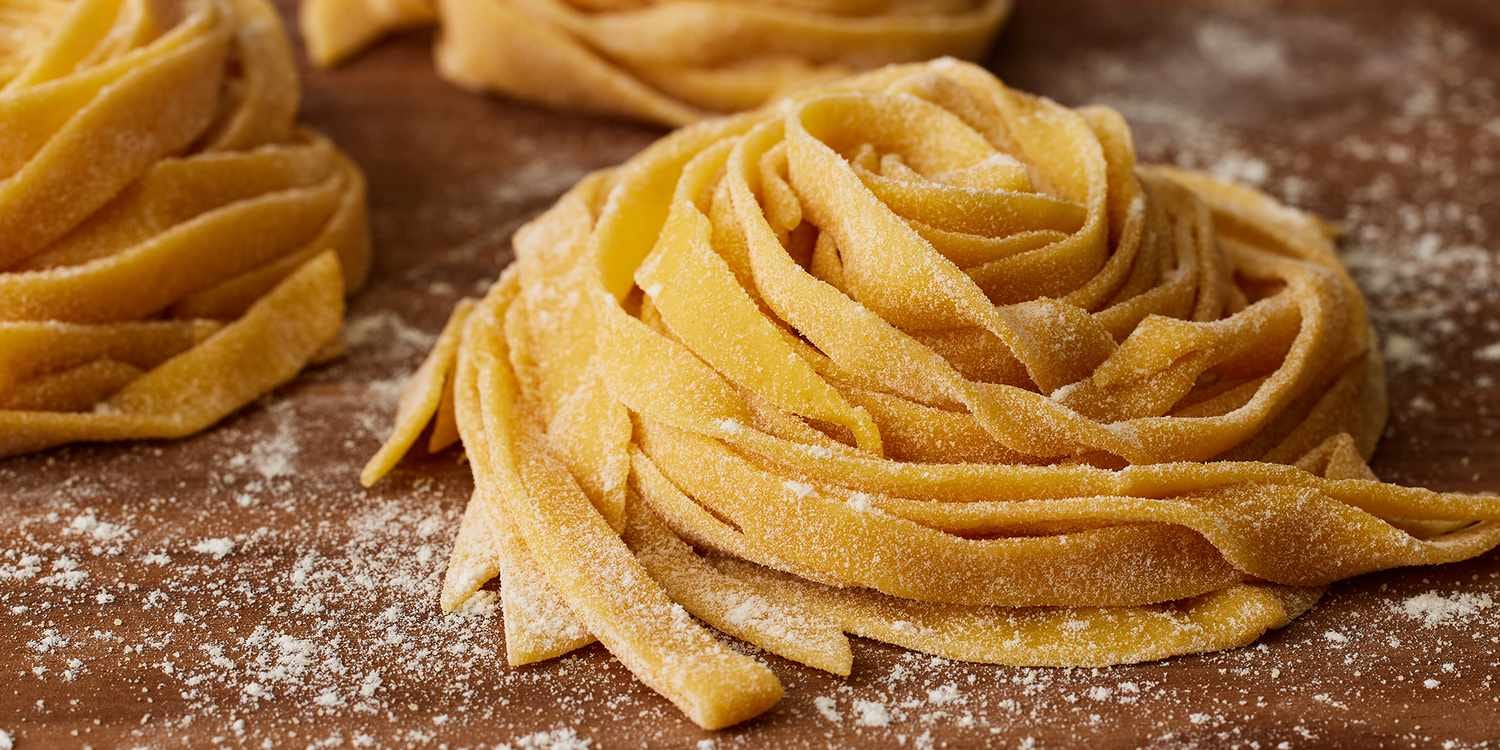
When pasta dough is forced through a bronze die (how it’s always been done in Italy), the metal's natural roughness creates microscopic tears on the surface of the noodle. This gives bronze-extruded pasta its porous, matte, slightly chalky finish that sauce clings to. It is the reason good Italian pasta has that beautiful texture you can feel in your hand, and why a ragù clings to it so easily instead of sliding off into a puddle at the bottom of the bowl.
On the other hand, teflon-coated dies are smooth. They produce a glossy, slick, often bright-yellow noodle that sauce slides right off. Industrial producers use Teflon because it is cheaper, faster, easier to clean, and turns out a more uniform product (all the many reasons why so much of the food system has just turned into absolute slop - at the expense of our health).
In essence, bronze-die pasta is more porous and less dense than Teflon-die pasta and this isn’t even the worst part. In the same way that we avoid teflon pans, this teflon coated method is providing you with plastic pasta. Giada De Laurentiis recently raised the concern that American Teflon-coated pasta dies may leach microplastics into the food during the high-heat extrusion process and this is not ideal for your gut.
Slow low-temperature drying vs flash high-temperature drying
Traditional pasta making is an Art. Nonna would very carefully make her pasta and when it was time to dry, she would respectfully give the pasta the time it needs. Traditional pasta is dried slowly at low temperatures and this is a process that can take 24 to 48 hours. This preserves the wheat’s natural aroma and the authentic pale color of semolina, keeping the structural integrity of the proteins intact.
Industrial pasta, including most American pasta, is flash-dried at high temperatures in just two or three hours. It is fast and of course it is cheap, but the thermal shock denatures the proteins, drives off the aroma, and leaves behind that oddly bright, neon-yellow color.
How different is the wheat itself?
Italian dried pasta is made from durum wheat, Triticum durum, a hard, high-protein wheat. Much of American pasta, and most American bread, leans on common wheat, Triticum aestivum, a softer variety. Durum has a tougher gluten and a lower glycemic index. It is, frankly, the better grain for pasta, which is exactly why Italian law insists on it.
Then there is the question of modern wheat versus ancient grains. Over the last century, wheat has been bred hard for yield and convenience. Ancient grains like einkorn, emmer, and khorasan are far closer to what wheat used to be. Some research points to modern wheat carrying higher levels of certain proteins called amylase-trypsin inhibitors, or ATIs, which can switch on a low-level inflammatory response in sensitive people. That is one explanation for why some people feel “off” after eating modern wheat.
Most American wheat is also higher in gluten proteins than the softer European varieties. It is often grown in sulfur-poor soil and frequently sprayed with glyphosate, a practice far more restricted across Europe.
How are you eating your pasta?
The way you eat pasta matters as much as the pasta itself. In Italy, pasta is primo, a first course, not the oversized main event. A normal portion is just 80 to 100 grams of dried pasta. You eat it slowly, at a table, in conversation, usually with no phone in sight and often with a glass of wine. The meal might last an hour or two. Eating slowly and calmly puts your body into the state where it actually digests well. Especially when you get up after the meal and go for a cute little walk.
Compare that with the American default where portion size is larger. Pasta is eaten fast and followed by sitting at a desk or in a car. Whether you’re eating pasta or not, a post meal walk is one of the best things you can do for your digestion and mental clarity (especially after lunch).
Now, let’s talk pasta shape
Pasta shapes matter. You can have the best sauce in the world and pasta cooked perfectly al dente, but if you are not in the mood for pappardelle, it is just not going to hit. Before getting into the tier list, here are the broad categories pasta shapes fall into.
Long pasta, pasta lunga
Spaghetti, angel hair, linguine, fettuccine, tagliatelle, pappardelle, bucatini. Strands and ribbons. Long pasta works best with sauces that coat rather than cling. Olive oil and razor thin garlic. Light tomato. Seafood. Silky cream. The wider the ribbon, the heartier the sauce it can carry, which is why pappardelle is BEST for a slow ragù.
Short pasta, pasta corta
Penne, rigatoni, paccheri, garganelli, fusilli, cavatappi, casarecce, rotini, macaroni, anelli. Tubes and curls. Short pasta works best with chunky sauces. Every little ridge, hollow, and curve is a trap for bits of meat, herbs and texture. A good rigatoni with a thick amatriciana catches sauce inside and out.
Stuffed pasta, pasta ripiena
Ravioli, tortellini. Usually the egg pasta we talked about earlier, and here the filling is the star, so the sauce should not overshadow it. Think about a light tomato, a simple broth, etc. Drown a delicate tortellini in something heavy and you have wasted the filling entirely.
Baked pasta, pasta al forno
Lasagne sheets. Literally designed to hold their structure in the oven and soak up flavor over a long bake.
And of course we have the odd child - gnocchi - which I definitely see as more of a dumpling than pasta but hey, to each their own!

Now that we have that out of the way, remember - pasta shapes absolutely matter and not all shapes are created equal. So in classic WARKITCHEN fashion, we made another tier list that caused a stir. This tier list was made by collective opinion in our IG channel - WARKITCHEN SOIRÉE.
A few notes before you leave a hate comment. Yes, farfalle is in D tier. The bowtie looks real cute but that pinched center NEVER cooks evenly, and the community agreed: it was the single most overrated shape in the whole vote. Yes, rotini is down there as well. And dinosaur pasta sits at the very bottom (sorry kids but I never understood the hype - even as a five year old). Kids deserve REAL, beautiful pasta!
What’s your favorite pasta shape?
Announcement: We’re looking for more submissions for our much awaited FERTILITY print issue. We’re combining our fertility digital issues (Issue 32 & Issue 35) along with some exclusive recipes & articles. As some of you already know, this is going to be our first perpetual issue :)
The plan is for it to be a coffee table book you’ll pass down for generations, and one we’ll keep reprinting in the years to come. So if you’d like to be part of this, please send your pitch to rocky@warkitchen.net (or simply reply to this email in your inbox). Artists, writers, illustrators, flâneurs, models, designers, eccentrics - ALL WELCOME!
Here are some particular topics we’re looking for:- Everything about Birth [taken]- Endometriosis & PCOS [taken]
- Navigating Miscarriage
- Coming off birth control- Takes a village to raise a child [taken]
- Father’s role in fertility
- Postpartum traditions
- Postpartum guide
- Tracking your fertility
- Fertility centric recipes
- Other topics also welcome :)
Looking forward to reading your pitches! Also feel free to attach past work, etc 🙌

Mother’s day

We hope you got your whimsy back
Coconut lattes

Understand the art of coconut coffee (few)
Size doesn’t matter

Microfoods maxxing is the art of tastefully incorporating tiny (but powerful) servings of food in your daily meal architecture for compounding the likes the S&P500 has never seen before.
View time as life

Spending time is spending life; never forget that

❋ How To Make A Sorbet Without A Recipe by Edd Kimber

“At its essence, sorbet is simply a mix of water and sugar. When this mixture has the right balance of sweetness, you create a syrup with a low enough freezing point, which creates a sorbet that is smooth and without large ice crystals, scoopable straight from the freezer, and pleasant to eat. If the syrup is too high in sugar, it won't be able to freeze at all (sugar doesn’t freeze) and will be loose and slushy even after hours in the freezer. If the syrup has too little sugar, the sorbet will freeze like a block of ice and will be unpleasantly icy.
The perfect sorbet is made with a syrup that is about 20–30% sugar. With water and sugar, this is obviously easy, but when you add in a fruit puree, judging, this is much trickier. When talking about the sugar in sorbet, I am referring to ‘total sugars’ not just ‘added sugars,’ so the fruit, which contains naturally occurring sugars, makes calculating the right amount to use much more complicated. Professionals use a tool called a refractometer, which can measure the concentration of sugar in a given liquid. Unless you want to buy one of these fancy tools, what are your other options? Remember when I said I would teach you a cool trick to make sorbet without a recipe? Well, that cool trick is an egg. Yes, you read that correctly, an egg. When you’ve made a sorbet base, a mixture of fruit puree and sugar, you can measure its sugar content by dropping in an egg. How the egg floats tells us how much sugar is contained.” — Edd Kimber
❋ Breastfeeding essentials from a crunchy, minimalist mom by Mia K Hansen [Paid Post]

“Six months into exclusive breastfeeding, and I can honestly say it has become one of the sweetest parts of motherhood for me. It’s not always easy or glamorous, but it has surely been far more intuitive than I expected once I stopped overcomplicating it.
I’ve found that the less I bought, the less I stressed, and the more I trusted my body and my baby, the smoother breastfeeding became.
There are entire aisles dedicated to breastfeeding products now. Special gadgets. Supplements. Devices. Schedules. Apps. Systems. I’m here to tell you that you don’t need it all. Or really much of anything at all.
After six months of nursing day and night, these are the things that actually worked for me, the things I truly used daily, and the habits that made breastfeeding feel effortless. Also, what I did to recover from mastitis naturally to avoid nuking my gut (and baby’s gut) with antibiotics. And of course, my controversial take on pumping.” — Mia K Hansen
❋ Strawberry cinnamon roll bites by Kiley Heard

“These Strawberry Cinnamon Roll Bites are soft, fluffy, and insanely gooey in the best way. Each little bite is rolled in a warm brown sugar cinnamon mixture so you get that classic cinnamon roll flavor all the way through. Then they’re layered with a bright, jammy homemade strawberry compote and a brown sugar syrup that sinks into every single nook and cranny — ugh it’s just so good.” — Kiley Heard
❋ A collection of things i've been loving by Valerie Ribon

“Collecting vintage books. i recently got a pre-rockefeller herbalism book (culpepper’s herbal- it’s a classic). i just bought a first edition of bambi and can barely wait for it to arrive. i want to have a very small collection of vintage books- super intentional ones. they make me so happy. i need to find the perfect way to display them. by the way, i’ve been sourcing all of my vintage books from ebay!” — Valerie Ribon
❋ Why You Need to be Bindermaxxing by Noah Ryan

“The modern toxic load is categorically different. Humans evolved with a baseline toxin exposure tolerance (smoke from fires, phytochemicals, microbial toxins), but we are triple digit multiples over our detox capacity.
Glyphosate, microplastics, PFAS, heavy metals, mycotoxins, phthalates, pharmaceutical residues, pesticides, industrial solvents. No prior generation of humans has faced this combination at this concentration with this level of bioaccumulation.Your detox pathways are over capacity. Your glutathione is depleted and your liver is likely recirculating toxins as we speak.
Binders break this loop. They absorb toxins in the gastrointestinal tract (before they hit your liver) and carry them out through stool. Literally a cheat code for detox.” — Noah Ryan
❋ Mary Berry’s easy sticky toffee pudding

“Mary's all-in-one sticky toffee pudding is sticky, gooey and remarkably easy. Baked in a large dish, this is a family-sized pudding, spooned out or cut into squares to serve.
For this recipe you will need a 1.7-litre/3-pint ovenproof dish and an electric whisk.
Each serving provides 927 kcal, 9g protein, 88g carbohydrates (of which 60g sugars), 59g fat (of which 36g saturates), 1.5g fibre and 1.9g salt.”
More links:
❋ Don’t forget to feed your soul
❋ How to send wax sealed letters in the mail
❋ Does anyone care what you wear to a tennis match?
❋ Homemade herb ravioli recipe
❋ Pecorino Romano vs Parmigiano Reggiano
Have an amazing week!
— Rocky
❋ All our digital issues are free to peruse. Explore our latest:


❋ Winter 25/26 Coffee Table Book (Print)
❋ Explore the full WARKITCHEN archive here.
❋ May’s Spotify playlist (suggestions always welcome!)
❋ Got an article or recipe in mind? We’d love to hear more! Please send your pitch to rocky@warkitchen.net.
Too afraid to put gnocchi on S eh? Great post G, as always. Love that even sponsored stuff keeps the vibe and the care, hope it stays that way.